
Table of Contents
- What RN Delegation Means for Home Care
- Understanding Texas RN Delegation Rules
- Caregiver Delegated Nursing Tasks: What’s Allowed
- RN Delegation Assessment and Care Plan Development
- RN Delegation Training for Caregivers: What to Expect
- Legal and Ethical Responsibilities in Delegation
- When and How to Adjust Delegated Tasks
- Frequently Asked Questions
Last Updated: October 9, 2026
What RN Delegation Means for Home Care
[RN delegation](/rn-delegation-services-home-caregivers/) for home caregivers explained is the process where a registered nurse authorizes a trained caregiver to perform specific nursing tasks under the nurse’s supervision and guidance. This isn’t the caregiver working independently, it’s a structured arrangement where the RN retains clinical responsibility while the caregiver carries out delegated duties.
Think of it as a partnership. The RN assesses the patient’s needs, creates a care plan, trains the caregiver, and monitors the results. The caregiver then performs the allowed tasks while staying in regular contact with the RN. This model lets families receive skilled care at home without requiring a nurse to be present 24/7.
For families in the Dallas-Fort Worth area managing aging parents or loved ones with complex medical needs, RN delegation bridges a critical gap. It makes home care safer, more affordable, and more practical than institutional settings.
The key difference: delegation is NOT the same as supervision. A supervised caregiver works under direct oversight. A delegated caregiver works with clear instructions and regular check-ins. The RN sets the boundaries. The caregiver respects them.
Understanding Texas RN Delegation Rules
Texas has specific regulations governing how nurses can delegate tasks to unlicensed caregivers. These rules exist to protect patients while allowing qualified caregivers to provide essential care.
The Texas Board of Nursing sets the legal framework. Delegation must be based on the patient’s condition, the caregiver’s training, and the task’s complexity. Not every nursing task can be delegated. Some require a licensed nurse to perform them directly.
Key principles in Texas include:
- The RN must assess whether delegation is safe for this specific patient
- The task must be within the caregiver’s demonstrated competence
- The RN must provide clear written instructions
- The RN must monitor the caregiver’s performance regularly
- The caregiver must report problems immediately
For families navigating these rules in Colleyville and surrounding areas, understanding what’s legal and safe is essential.
Care Crew LLC operates under Texas Board of Nursing RN delegated task rules. This means every caregiver we work with has been properly assessed, trained, and monitored by a registered nurse who takes clinical responsibility for the delegated work.
Delegation without proper assessment, training, or RN oversight violates Texas nursing regulations and puts the patient at serious risk. Never ask a caregiver to perform a task without explicit RN authorization.
Caregiver Delegated Nursing Tasks: What’s Allowed
Not every nursing task can be delegated. Texas law and nursing ethics create clear boundaries. Understanding what CAN be delegated helps families make informed decisions about their loved one’s care.
Common Examples of Delegated Tasks
Caregivers working under RN delegation commonly perform these tasks:
- Medication reminders: Reminding the patient to take medications at scheduled times (the patient self-administers)
- Vital sign monitoring: Taking blood pressure, temperature, pulse, and respiration rates and reporting results to the RN
- Wound care assistance: Helping change dressings under RN-written instructions
- Catheter care: Emptying and cleaning catheters following specific protocols
- Hygiene and grooming: Assisting with bathing, toileting, and personal care
- Feeding and nutrition: Helping with meals and monitoring fluid intake
- Mobility assistance: Helping the patient move, transfer, and walk safely
- Range-of-motion exercises: Assisting with prescribed stretches and movements
- Catheter specimen collection: Collecting samples for testing per RN instructions
- Ostomy care: Emptying and cleaning ostomy pouches
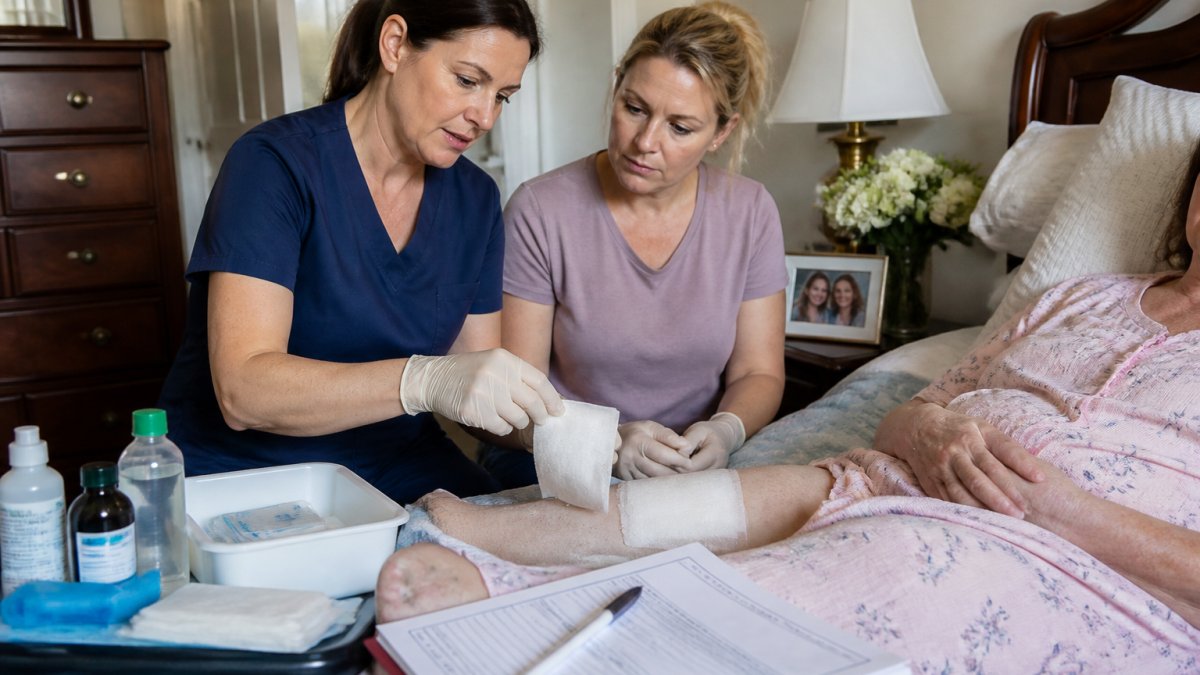
These tasks are delegable because they don’t require independent nursing judgment. The RN has already assessed the patient and written clear instructions. The caregiver follows the plan.
When an RN delegates a task, ask for written instructions. Having documentation protects both the caregiver and the patient. The caregiver knows exactly what to do. The RN has a record of what was taught.
Tasks That Cannot Be Delegated
Some nursing functions require a licensed nurse to perform them. These tasks involve clinical judgment, assessment, or direct patient evaluation that only an RN can provide.
Tasks that CANNOT be delegated include:
- Initial patient assessment: Evaluating the patient’s condition to create a care plan
- Nursing diagnosis: Determining what nursing problems exist
- Care plan development: Creating or modifying the treatment plan
- Medication administration: Giving medications by any route (IV, injection, oral)
- Complex wound care: Assessing wounds, determining treatment, or performing sterile procedures
- Catheter insertion: Placing a new catheter or managing complicated catheter issues
- Tracheostomy care: Managing a tracheostomy tube or suctioning
- IV therapy: Starting IVs, managing lines, or troubleshooting infusion problems
- Tube feeding management: Inserting feeding tubes or managing tube placement
- Complex medical decisions: Deciding whether to call a doctor or adjust care based on changes in the patient’s condition
The line is clear: if the task requires the RN to think, assess, or make clinical decisions, the RN must do it. If the task is routine and the RN has provided clear instructions, the caregiver can do it.
Delegation works when the RN has already done the thinking. The caregiver follows a proven plan. If the situation is new or unusual, the RN needs to be involved.
RN Delegation Assessment and Care Plan Development
Before any task can be delegated, the RN must complete a thorough assessment. This isn’t a quick checklist. It’s a detailed evaluation of the patient’s condition, the caregiver’s abilities, and the specific task.
The assessment includes:
- Patient evaluation: Current health status, medical history, medications, and any complications
- Task analysis: What exactly needs to be done, how often, and what could go wrong
- Caregiver evaluation: The person’s education, experience, physical ability, and reliability
- Environment assessment: Is the home safe for this task? Are supplies available?
- Risk evaluation: What could go wrong, and how would the caregiver respond?
Once the assessment is complete, the RN creates a written care plan. This plan documents what tasks are delegated, how to perform them, what to monitor, and when to call the RN.
For families in the Dallas-Fort Worth area, the RN evaluates your loved one’s specific situation and creates a plan tailored to their needs.
The care plan is a living document. As the patient’s condition changes, the RN reassesses. Tasks may be added, removed, or modified. The RN stays connected to the patient’s progress.
RN Delegation Training for Caregivers: What to Expect
Training is where delegation becomes real. A caregiver can’t perform a task safely without proper instruction. The RN’s job includes teaching the caregiver, watching them perform the task, and confirming competence.
Effective training includes:
- Explanation: The RN explains WHY the task matters and what could go wrong
- Demonstration: The RN shows the caregiver exactly how to do the task correctly
- Supervised practice: The caregiver performs the task while the RN watches and corrects
- Competency confirmation: The RN confirms the caregiver can do it safely, independently
- Written instructions: The caregiver receives step-by-step written guidelines to reference
- Ongoing support: The RN remains available for questions and troubleshooting
Training isn’t one-time. As the patient’s needs change or new tasks are added, the RN provides additional training. The caregiver isn’t expected to remember everything from day one.
Many families ask: How long does training take? It varies. The RN doesn’t rush. Competence matters more than speed.
Good training includes a written handout the caregiver can reference. If the caregiver forgets a step, they shouldn’t have to call the RN every time. Written instructions reduce errors and build confidence.
Legal and Ethical Responsibilities in Delegation
Delegation creates legal responsibility for both the RN and the caregiver. Understanding these responsibilities protects everyone.
The RN’s responsibilities:
- Assess whether delegation is safe for this patient
- Provide clear, written instructions
- Train the caregiver and confirm competence
- Monitor the caregiver’s performance regularly
- Respond to problems and adjust the plan as needed
- Document everything in the patient’s medical record
The caregiver’s responsibilities:
- Follow the RN’s instructions exactly as written
- Perform the task safely and competently
- Report any problems or changes to the RN immediately
- Ask for help if unsure about anything
- Never perform a task outside the delegated scope
- Keep the patient’s information confidential
If something goes wrong, the RN is clinically responsible. The RN chose to delegate. The RN provided the training. If the caregiver didn’t follow instructions, that’s a problem too. But the RN’s oversight is the foundation.
For families in Colleyville and the surrounding area, this means you need an RN you trust. The RN’s judgment directly affects your loved one’s safety. Care Crew LLC’s approach emphasizes ongoing communication. The RN is actively involved in monitoring and supporting the caregiver’s work.
Documentation is critical. Every delegated task, every training session, every problem should be documented. Documentation protects the patient, the caregiver, and the RN if questions arise later.
When and How to Adjust Delegated Tasks
As your loved one’s health changes, delegated tasks may need adjustment. The RN monitors for these changes and modifies the plan accordingly.
Signs that tasks need adjustment:
- Patient’s condition worsens: New symptoms, increased confusion, or declining mobility
- Caregiver struggles: The caregiver can’t perform a task safely or consistently
- New medical problems: A new diagnosis or medication change affects what’s safe to delegate
- Task is no longer needed: The patient recovers or the situation resolves
When changes occur, the RN reassesses. This might mean:
- Adding new delegated tasks the caregiver can now handle
- Removing tasks that are no longer appropriate
- Increasing the frequency of RN check-ins
- Providing additional training for a modified task
- Bringing in a nurse for tasks that must be done by licensed staff
At Care Crew LLC, we encourage families to communicate openly. If the caregiver is struggling, tell us. If your loved one’s condition is changing, tell us. The RN needs this information to keep your loved one safe.
Delegating nursing care to a trained caregiver is a practical solution for families managing complex home care needs. But delegation only works when an RN is actively involved, assessing, training, and monitoring. For families in the Dallas-Fort Worth area navigating these decisions, having a partner who understands both the regulations and the reality of home care makes all the difference. Care Crew LLC brings registered nurse oversight and personalized delegation planning to help your loved one receive safe, appropriate care at home. Call now to discuss your care situation and learn how delegation can support your family’s needs.
Frequently Asked Questions
What is RN delegation in home care?
RN delegation is the process by which a registered nurse assigns specific nursing tasks to a trained home caregiver while maintaining clinical oversight and responsibility. The RN provides initial assessment, training, written instructions, and ongoing supervision to ensure the caregiver can safely perform the delegated task. The RN remains accountable for the delegation decision and the client’s overall care plan, even though the caregiver performs the hands-on work.
What tasks can an RN delegate to a home caregiver in Texas?
Under Texas RN delegation rules, RNs may delegate tasks such as assistance with hygiene and dressing, catheter care, wound cleaning and dressing changes, glucose monitoring, medication reminders, and certain personal care activities. However, the RN must assess each client individually to determine appropriateness. Tasks requiring independent nursing judgment, such as medication administration decisions or complex wound assessment, cannot be delegated. The RN documents all delegated tasks in the care plan.
Does a caregiver need special training to perform a delegated task?
Yes. Before performing any delegated task, the caregiver must receive training and demonstration from the RN. The RN evaluates the caregiver’s competency and documents that training in the client’s record. The level of training depends on the complexity of the task and the caregiver’s prior experience. The RN may require the caregiver to demonstrate the task back to ensure understanding before performing it independently.
Who is responsible if something goes wrong with a delegated task?
The RN who delegated the task holds primary responsibility for the delegation decision, the appropriateness of the assignment, and the quality of training provided. However, the caregiver is responsible for performing the task safely and correctly according to the RN’s instructions and for reporting any problems or changes in the client’s condition. Both the RN and caregiver share responsibility for maintaining open communication and documenting outcomes.